Showing Food Pineapple
| General Information | |||||||||||
|---|---|---|---|---|---|---|---|---|---|---|---|
| Name | Pineapple | ||||||||||
| Scientific Name | Ananas comosus | ||||||||||
| Description | The Pineapple (Ananas comosus), named for its resemblance to the pine cone, is a tropical plant with edible multiple fruit consisting of coalesced berries, and the most economically significant plant in the Bromeliaceae family. Pineapples may be cultivated from a crown cutting of the fruit, possibly flowering in 20–24 months and fruiting in the following six months. Pineapple does not ripen significantly post-harvest. Pineapples are consumed fresh, cooked, juiced, and preserved, and are found in a wide array of cuisines. In addition to consumption, in the Philippines the pineapple's leaves are used to produce the textile fiber piña- employed as a component of wall paper and furnishings, amongst other uses. | ||||||||||
| Primary ID | FOOD00012 | ||||||||||
| Picture | 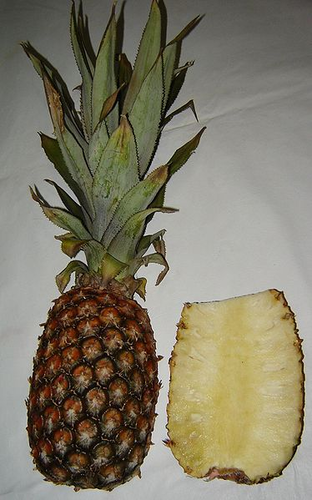 | ||||||||||
| Classification | |||||||||||
| Group | Fruits | ||||||||||
| Sub-Group | Tropical fruits | ||||||||||
| Taxonomy | |||||||||||
| Superkingdom | Eukaryota | ||||||||||
| Kingdom | Viridiplantae | ||||||||||
| Phylum | Streptophyta | ||||||||||
| Class | Magnoliopsida | ||||||||||
| Order | Poales | ||||||||||
| Family | Bromeliaceae | ||||||||||
| Genus | Ananas | ||||||||||
| Species | comosus | ||||||||||
| Variety | Not Available | ||||||||||
| External Links | |||||||||||
| ITIS ID | 42335 | ||||||||||
| Wikipedia ID | Pineapple | ||||||||||
| Composition | |||||||||||
| Compounds |
Processing... | ||||||||||
| Macronutrients |
Processing... | ||||||||||
| References | |||||||||||
| Content Reference | — Duke, James. 'Dr. Duke's Phytochemical and Ethnobotanical Databases. United States Department of Agriculture.' Agricultural Research Service, Accessed April 27 (2004). — Saxholt, E., et al. 'Danish food composition databank, revision 7.' Department of Nutrition, National Food Institute, Technical University of Denmark (2008). — U.S. Department of Agriculture, Agricultural Research Service. 2008. USDA National Nutrient Database for Standard Reference, Release 21. Nutrient Data Laboratory Home Page. — Rothwell JA, Pérez-Jiménez J, Neveu V, Medina-Ramon A, M'Hiri N, Garcia Lobato P, Manach C, Knox K, Eisner R, Wishart D, Scalbert A. (2013) Phenol-Explorer 3.0: a major update of the Phenol-Explorer database to incorporate data on the effects of food processing on polyphenol content. Database, 10.1093/database/bat070. — Shinbo, Y., et al. 'KNApSAcK: a comprehensive species-metabolite relationship database.' Plant Metabolomics. Springer Berlin Heidelberg, 2006. 165-181. | ||||||||||