Showing Food Common buckwheat
| General Information | |||||||||||
|---|---|---|---|---|---|---|---|---|---|---|---|
| Name | Common buckwheat | ||||||||||
| Scientific Name | Fagopyrum esculentum | ||||||||||
| Description | Buckwheat (Fagopyrum esculentum) is a plant cultivated for its grain-like seeds, and also used as a cover crop. Despite the name, buckwheat is not related to wheat, as it is not a grass; instead, buckwheat is related to sorrel, knotweed, and rhubarb. The cultivation of buckwheat grain declined sharply in the 20th century with the adoption of nitrogen fertilizer that increased the productivity of other staples. A related species, Fagopyrum tataricum (Tartary buckwheat) is also cultivated as a grain in the Himalayas. | ||||||||||
| Primary ID | FOOD00079 | ||||||||||
| Picture | 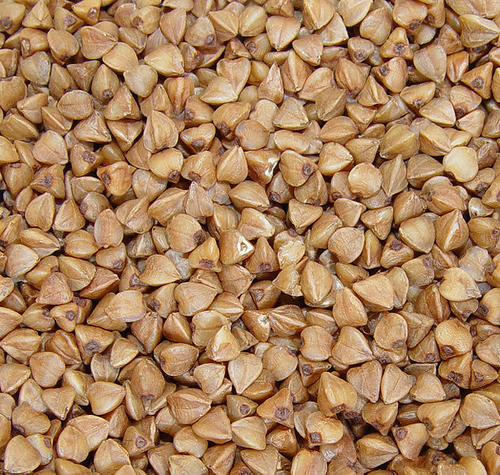 | ||||||||||
| Classification | |||||||||||
| Group | Cereals and cereal products | ||||||||||
| Sub-Group | Cereals | ||||||||||
| Taxonomy | |||||||||||
| Superkingdom | Eukaryota | ||||||||||
| Kingdom | Viridiplantae | ||||||||||
| Phylum | Streptophyta | ||||||||||
| Class | Magnoliopsida | ||||||||||
| Order | Caryophyllales | ||||||||||
| Family | Polygonaceae | ||||||||||
| Genus | Fagopyrum | ||||||||||
| Species | esculentum | ||||||||||
| Variety | Not Available | ||||||||||
| External Links | |||||||||||
| ITIS ID | 502589 | ||||||||||
| Wikipedia ID | Buckwheat | ||||||||||
| Composition | |||||||||||
| Compounds |
Processing... | ||||||||||
| Macronutrients |
Processing... | ||||||||||
| References | |||||||||||
| Content Reference | — Duke, James. 'Dr. Duke's Phytochemical and Ethnobotanical Databases. United States Department of Agriculture.' Agricultural Research Service, Accessed April 27 (2004). — Saxholt, E., et al. 'Danish food composition databank, revision 7.' Department of Nutrition, National Food Institute, Technical University of Denmark (2008). — U.S. Department of Agriculture, Agricultural Research Service. 2008. USDA National Nutrient Database for Standard Reference, Release 21. Nutrient Data Laboratory Home Page. — Rothwell JA, Pérez-Jiménez J, Neveu V, Medina-Ramon A, M'Hiri N, Garcia Lobato P, Manach C, Knox K, Eisner R, Wishart D, Scalbert A. (2013) Phenol-Explorer 3.0: a major update of the Phenol-Explorer database to incorporate data on the effects of food processing on polyphenol content. Database, 10.1093/database/bat070. — Shinbo, Y., et al. 'KNApSAcK: a comprehensive species-metabolite relationship database.' Plant Metabolomics. Springer Berlin Heidelberg, 2006. 165-181. | ||||||||||