Showing Food Nutmeg
| General Information | |||||||||||
|---|---|---|---|---|---|---|---|---|---|---|---|
| Name | Nutmeg | ||||||||||
| Scientific Name | Myristica fragrans | ||||||||||
| Description | The nutmeg tree is any of several species of trees in genus Myristica. The most important commercial species is Myristica fragrans, an evergreen tree indigenous to the Banda Islands in the Moluccas (or Spice Islands) of Indonesia. The nutmeg tree is important for two spices derived from the fruit: nutmeg and mace. Nutmeg is the seed of the tree, roughly egg-shaped and about 20 to 30 mm (0.8 to 1.2 in) long and 15 to 18 mm (0.6 to 0.7 in) wide, and weighing between 5 and 10 g (0.2 and 0.4 oz) dried, while mace is the dried "lacy" reddish covering or aril of the seed. The first harvest of nutmeg trees takes place 7-9 years after planting, and the trees reach full production after twenty years. Nutmeg is usually used in powdered form. This is the only tropical fruit that is the source of two different spices. Several other commercial products are also produced from the trees, including essential oils, extracted oleoresins, and nutmeg butter . The common or fragrant nutmeg, Myristica fragrans, native to the Banda Islands of Indonesia, is also grown in Penang Island in Malaysia and the Caribbean, especially in Grenada. It also grows in Kerala, a state in southern India. Other species of nutmeg include Papuan nutmeg M. argentea from New Guinea, and M. malabarica from India. In low doses, nutmeg produces no noticeable physiological or neurological response, but in large doses, raw nutmeg has psychoactive effects.[citation needed] In its freshly ground form (from whole nutmegs), nutmeg contains myristicin, a monoamine oxidase inhibitor and psychoactive substance.[citation needed] Myristicin poisoning can induce convulsions, palpitations, nausea, eventual dehydration, and generalized body pain. Fatal myristicin poisonings in humans are very rare. | ||||||||||
| Primary ID | FOOD00118 | ||||||||||
| Picture | 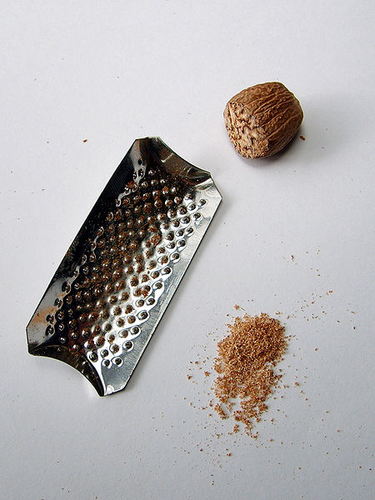 | ||||||||||
| Classification | |||||||||||
| Group | Herbs and Spices | ||||||||||
| Sub-Group | Spices | ||||||||||
| Taxonomy | |||||||||||
| Superkingdom | Eukaryota | ||||||||||
| Kingdom | Viridiplantae | ||||||||||
| Phylum | Streptophyta | ||||||||||
| Class | Magnoliopsida | ||||||||||
| Order | Magnoliales | ||||||||||
| Family | Myristicaceae | ||||||||||
| Genus | Myristica | ||||||||||
| Species | fragrans | ||||||||||
| Variety | Not Available | ||||||||||
| External Links | |||||||||||
| ITIS ID | 18125 | ||||||||||
| Wikipedia ID | Nutmeg | ||||||||||
| Composition | |||||||||||
| Compounds |
Processing... | ||||||||||
| Macronutrients |
Processing... | ||||||||||
| References | |||||||||||
| Content Reference | — Duke, James. 'Dr. Duke's Phytochemical and Ethnobotanical Databases. United States Department of Agriculture.' Agricultural Research Service, Accessed April 27 (2004). — Saxholt, E., et al. 'Danish food composition databank, revision 7.' Department of Nutrition, National Food Institute, Technical University of Denmark (2008). — U.S. Department of Agriculture, Agricultural Research Service. 2008. USDA National Nutrient Database for Standard Reference, Release 21. Nutrient Data Laboratory Home Page. — Rothwell JA, Pérez-Jiménez J, Neveu V, Medina-Ramon A, M'Hiri N, Garcia Lobato P, Manach C, Knox K, Eisner R, Wishart D, Scalbert A. (2013) Phenol-Explorer 3.0: a major update of the Phenol-Explorer database to incorporate data on the effects of food processing on polyphenol content. Database, 10.1093/database/bat070. — Shinbo, Y., et al. 'KNApSAcK: a comprehensive species-metabolite relationship database.' Plant Metabolomics. Springer Berlin Heidelberg, 2006. 165-181. | ||||||||||