Showing Food European plum
| General Information | |||||||||||
|---|---|---|---|---|---|---|---|---|---|---|---|
| Name | European plum | ||||||||||
| Scientific Name | Prunus domestica | ||||||||||
| Description | Prunus domestica (sometimes referred to as Prunus × domestica) is a species of flowering plant in the family Rosaceae. A deciduous tree, it includes many varieties of the fruit trees known as plums in English, though not all plums belong to this species. The greengages and damsons also belong to subspecies of P. domestica. Its hybrid parentage is believed to be Prunus spinosa and Prunus cerasifera. This is the most commonly grown plum at least in Europe, and most prunes (dried plums) are made from fruits of this species. | ||||||||||
| Primary ID | FOOD00147 | ||||||||||
| Picture | 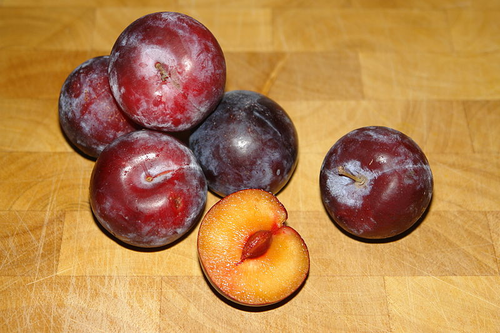 | ||||||||||
| Classification | |||||||||||
| Group | Fruits | ||||||||||
| Sub-Group | Drupes | ||||||||||
| Taxonomy | |||||||||||
| Superkingdom | Eukaryota | ||||||||||
| Kingdom | Viridiplantae | ||||||||||
| Phylum | Streptophyta | ||||||||||
| Class | Magnoliopsida | ||||||||||
| Order | Rosales | ||||||||||
| Family | Rosaceae | ||||||||||
| Genus | Prunus | ||||||||||
| Species | domestica | ||||||||||
| Variety | Not Available | ||||||||||
| External Links | |||||||||||
| ITIS ID | 24774 | ||||||||||
| Wikipedia ID | Prunus_domestica | ||||||||||
| Composition | |||||||||||
| Compounds |
Processing... | ||||||||||
| Macronutrients |
Processing... | ||||||||||
| References | |||||||||||
| Content Reference | — Duke, James. 'Dr. Duke's Phytochemical and Ethnobotanical Databases. United States Department of Agriculture.' Agricultural Research Service, Accessed April 27 (2004). — Saxholt, E., et al. 'Danish food composition databank, revision 7.' Department of Nutrition, National Food Institute, Technical University of Denmark (2008). — U.S. Department of Agriculture, Agricultural Research Service. 2008. USDA National Nutrient Database for Standard Reference, Release 21. Nutrient Data Laboratory Home Page. — Rothwell JA, Pérez-Jiménez J, Neveu V, Medina-Ramon A, M'Hiri N, Garcia Lobato P, Manach C, Knox K, Eisner R, Wishart D, Scalbert A. (2013) Phenol-Explorer 3.0: a major update of the Phenol-Explorer database to incorporate data on the effects of food processing on polyphenol content. Database, 10.1093/database/bat070. — Shinbo, Y., et al. 'KNApSAcK: a comprehensive species-metabolite relationship database.' Plant Metabolomics. Springer Berlin Heidelberg, 2006. 165-181. | ||||||||||