Showing Food Almond
| General Information | |||||||||||
|---|---|---|---|---|---|---|---|---|---|---|---|
| Name | Almond | ||||||||||
| Scientific Name | Prunus dulcis | ||||||||||
| Description | The almond (Prunus dulcis, syn. Prunus amygdalus, Amygdalus communis, Amygdalus dulcis) (or badam in Indian English, from Persian: بادام ) is a species of tree native to the Middle East and South Asia. "Almond" is also the name of the edible and widely cultivated seed of this tree. Within the genus Prunus, it is classified with the peach in the subgenus Amygdalus, distinguished from the other subgenera by the corrugated shell (endocarp) surrounding the seed. The fruit of the almond is a drupe, consisting of an outer hull and a hard shell with the seed (which is not a true nut) inside. Shelling almonds refers to removing the shell to reveal the seed. Almonds are sold shelled (i.e., after the shells are removed), or unshelled (i.e., with the shells still attached). Blanched almonds are shelled almonds that have been treated with hot water to soften the seedcoat, which is then removed to reveal the white embryo. | ||||||||||
| Primary ID | FOOD00148 | ||||||||||
| Picture | 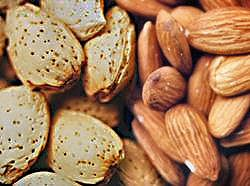 | ||||||||||
| Classification | |||||||||||
| Group | Nuts | ||||||||||
| Sub-Group | Nuts | ||||||||||
| Taxonomy | |||||||||||
| Superkingdom | Eukaryota | ||||||||||
| Kingdom | Viridiplantae | ||||||||||
| Phylum | Streptophyta | ||||||||||
| Class | Magnoliopsida | ||||||||||
| Order | Rosales | ||||||||||
| Family | Rosaceae | ||||||||||
| Genus | Prunus | ||||||||||
| Species | dulcis | ||||||||||
| Variety | Not Available | ||||||||||
| External Links | |||||||||||
| ITIS ID | 24775 | ||||||||||
| Wikipedia ID | Prunus_dulcis | ||||||||||
| Composition | |||||||||||
| Compounds |
Processing... | ||||||||||
| Macronutrients |
Processing... | ||||||||||
| References | |||||||||||
| Content Reference | — Duke, James. 'Dr. Duke's Phytochemical and Ethnobotanical Databases. United States Department of Agriculture.' Agricultural Research Service, Accessed April 27 (2004). — Saxholt, E., et al. 'Danish food composition databank, revision 7.' Department of Nutrition, National Food Institute, Technical University of Denmark (2008). — U.S. Department of Agriculture, Agricultural Research Service. 2008. USDA National Nutrient Database for Standard Reference, Release 21. Nutrient Data Laboratory Home Page. — Rothwell JA, Pérez-Jiménez J, Neveu V, Medina-Ramon A, M'Hiri N, Garcia Lobato P, Manach C, Knox K, Eisner R, Wishart D, Scalbert A. (2013) Phenol-Explorer 3.0: a major update of the Phenol-Explorer database to incorporate data on the effects of food processing on polyphenol content. Database, 10.1093/database/bat070. — Shinbo, Y., et al. 'KNApSAcK: a comprehensive species-metabolite relationship database.' Plant Metabolomics. Springer Berlin Heidelberg, 2006. 165-181. | ||||||||||