| General Information |
|---|
| Name | Pear |
|---|
| Scientific Name | Pyrus communis |
|---|
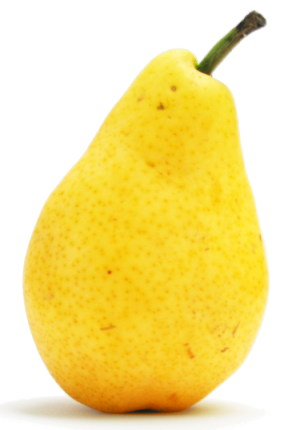
| Description | Pear, Pyrus communis, is a species of pear native to central and eastern Europe, and western Asia. It is widely consumed in many countries, particularly in Europe and North America. Pears are eaten fresh, canned, as juice, and dried, with the juice also used in jellies and jams, usually in combination with other fruits. The fruit is typically green, yellow, or red in color, with a sweet, buttery taste and a mild, sweet odor. Pears are a good source of dietary fiber, vitamins, and antioxidants, providing several health benefits, including promoting digestive health and reducing the risk of chronic diseases (PMID: 31281586). The most notable chemical in pears is fructose, a simple sugar (PMID: 40149091). Pear juice has been used in traditional medicine to treat various ailments, including digestive issues. Interestingly, pears are often picked when mature but still hard, and then ripened off the tree, a process that requires careful handling to avoid bruising the fruit. |
|---|
| Primary ID | FOOD00152 |
|---|
| Picture |  |
|---|
| Classification |
|---|
| Group | Fruits |
|---|
| Sub-Group | Pomes |
|---|
| Taxonomy |
|---|
| Superkingdom | Eukaryota |
|---|
| Kingdom | Viridiplantae |
|---|
| Phylum | Streptophyta |
|---|
| Class | Magnoliopsida |
|---|
| Order | Rosales |
|---|
| Family | Rosaceae |
|---|
| Genus | Pyrus |
|---|
| Species | communis |
|---|
| Variety | Not Available |
|---|
| External Links |
|---|
| ITIS ID | 25295 |
|---|
| Wikipedia ID | Pear |
|---|
| Composition |
|---|
| Compounds |
| Compound | Structure | Content Range | Average | Reference |
|---|
| Compound | | | | Reference |
|---|
|
|---|
| Macronutrients | | Macronutrient | Content Range | Average | Reference |
|---|
| Nutrient | | | Reference |
|---|
|
|---|
| Micronutrients | | Micronutrient | Content Range | Average | Reference |
|---|
| Nutrient | | | Reference |
|---|
|
|---|
| References |
|---|
| Content Reference | 15 unique sources. Numbers in the composition tables above point here. Show sources - [1] U.S. Department of Agriculture, Agricultural Research Service. 2008. USDA National Nutrient Database for Standard Reference, Release 21. Nutrient Data Laboratory Home Page. [USDA]
- [2] Saxholt, E., et al. Danish food composition databank, revision 7. Department of Nutrition, National Food Institute, Technical University of Denmark (2008). [DTU]
- [3] Rothwell JA, et al. (2013) Phenol-Explorer 3.0: a major update of the Phenol-Explorer database to incorporate data on the effects of food processing on polyphenol content. Database, 10.1093/database/bat070. [Phenol-Explorer]
- [4] Duke, James. Dr. Duke's Phytochemical and Ethnobotanical Databases. United States Department of Agriculture, Agricultural Research Service. [DUKE]
- [5] Shinbo, Y., et al. KNApSAcK: a comprehensive species-metabolite relationship database. Plant Metabolomics. Springer, 2006. 165-181. [KNApSAcK]
- [6] PhytoHub. A database of dietary phytochemicals and their human metabolites. [PhytoHub]
- [7] PMID 18778075
- [8] A. Escarpa and M. C. Gonzalez. Evaluation of High-Performance Liquid Chromatography for Determination of Phenolic Compounds in Pear Horticultural Cultivars. Chromatographia Vol. 51, No. 1/2, January 2000, 37-43
- [9] Christian Chervin, Jim Speirs, Brian Loveys, Brian D Patterson. Influence of low oxygen storage on aroma compounds of whole pears and crushed pear flesh. Postharvest Biology and Technology 19 (2000) 279-285
- [10] D. E. Heinz and W. C. Jennings. Volatile components of Bartlett Pear. V. Journal of Food Sci., 1966, 31(1), 69-80
- [11] Dilek Tanrioven and Aziz Eksi. Phenolic compounds in pear juice from different cultivars. Food Chemistry. 2005, 93(1), 89-93
- [12] P. B. Andrade, A. R. F. Carvalho, R. M. Seabra, and M. A. Ferreira. A Previous Study of Phenolic Profiles of Quince, Pear, and Apple Purees by HPLC Diode Array Detection for the Evaluation of Quince Puree Genuineness. J. Agric. Food Chem., 1998, 46 (3), pp 968-972. DOI: 10.1021/jf970571j
- [13] PathBank (predicted occurrence). [PathBank]
- [14] Human Metabolome Database (predicted occurrence). [HMDB]
- [15] MANUAL
|
|---|