Showing Food Jerusalem artichoke
| General Information | |||||||||||
|---|---|---|---|---|---|---|---|---|---|---|---|
| Name | Jerusalem artichoke | ||||||||||
| Scientific Name | Helianthus tuberosus | ||||||||||
| Description | The Jerusalem artichoke (Helianthus tuberosus), also called sunroot, sunchoke, earth apple or topinambour, is a species of sunflower native to eastern North America, and found from eastern Canada and Maine west to North Dakota, and south to northern Florida and Texas. It is also cultivated widely across the temperate zone for its tuber, which is used as a root vegetable. | ||||||||||
| Primary ID | FOOD00387 | ||||||||||
| Picture | 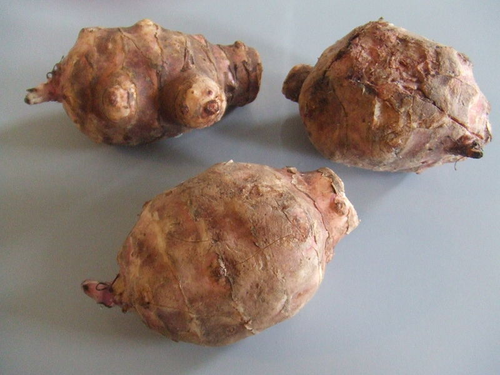 | ||||||||||
| Classification | |||||||||||
| Group | Vegetables | ||||||||||
| Sub-Group | Tubers | ||||||||||
| Taxonomy | |||||||||||
| Superkingdom | Eukaryota | ||||||||||
| Kingdom | Viridiplantae | ||||||||||
| Phylum | Streptophyta | ||||||||||
| Class | Magnoliopsida | ||||||||||
| Order | Asterales | ||||||||||
| Family | Asteraceae | ||||||||||
| Genus | Helianthus | ||||||||||
| Species | tuberosus | ||||||||||
| Variety | Not Available | ||||||||||
| External Links | |||||||||||
| ITIS ID | 36691 | ||||||||||
| Wikipedia ID | Jerusalem artichoke | ||||||||||
| Composition | |||||||||||
| Compounds |
Processing... | ||||||||||
| Macronutrients |
Processing... | ||||||||||
| References | |||||||||||
| Content Reference | — Duke, James. 'Dr. Duke's Phytochemical and Ethnobotanical Databases. United States Department of Agriculture.' Agricultural Research Service, Accessed April 27 (2004). — Saxholt, E., et al. 'Danish food composition databank, revision 7.' Department of Nutrition, National Food Institute, Technical University of Denmark (2008). — U.S. Department of Agriculture, Agricultural Research Service. 2008. USDA National Nutrient Database for Standard Reference, Release 21. Nutrient Data Laboratory Home Page. — Shinbo, Y., et al. 'KNApSAcK: a comprehensive species-metabolite relationship database.' Plant Metabolomics. Springer Berlin Heidelberg, 2006. 165-181. | ||||||||||