Showing Food Red bell pepper
| General Information | |||||||||||
|---|---|---|---|---|---|---|---|---|---|---|---|
| Name | Red bell pepper | ||||||||||
| Scientific Name | Capsicum annuum | ||||||||||
| Description | Red bell peppers are members of the domesticated plant species Capsicum annuum. Green, yellow, orange and red bell peppers all belong to the same species, with the differences arising from the time at which they are harvested. Green bell peppers are bell peppers that have been harvested early. Yellow and orange bell peppers have been allowed more time to ripen, and red bell peppers are the most mature. Capsicum annuum is a domesticated species of the plant genus Capsicum native to southern North America and northern South America. The three species C. annuum, C. frutescens and C. chinense all evolved from a single common ancestor located somewhere in the northwest Brazil - Colombia area. Capsicum annuum is the most common and extensively cultivated of the five domesticated capsicums. The species is a source of popular "sweet peppers":http://en.wikipedia.org/wiki/Bell_peppers and "hot chilis":http://en.wikipedia.org/wiki/Chili_pepper with numerous varieties cultivated all around the world. In American English the plant is commonly known as a chili pepper or bell pepper. In British English, the sweet varieties are called red or green peppers and the hot varieties chillies, whereas in Australian and Indian English the name capsicum is commonly used for bell peppers exclusively and chilli is often used to encompass the hotter varieties. [Wikipedia] See a "list of capsicum cultivars":http://en.wikipedia.org/wiki/List_of_Capsicum_cultivars. | ||||||||||
| Primary ID | FOOD00880 | ||||||||||
| Picture | 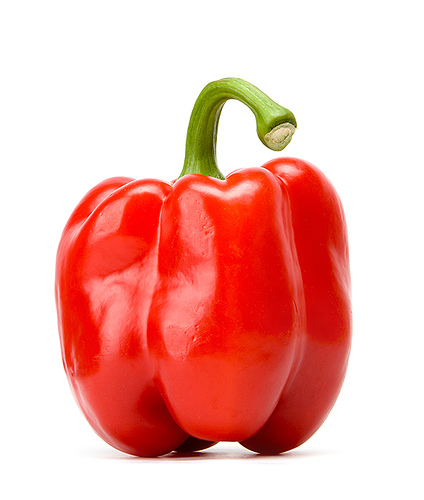 | ||||||||||
| Classification | |||||||||||
| Group | Vegetables | ||||||||||
| Sub-Group | Fruit vegetables | ||||||||||
| Taxonomy | |||||||||||
| Superkingdom | Eukaryota | ||||||||||
| Kingdom | Viridiplantae | ||||||||||
| Phylum | Streptophyta | ||||||||||
| Class | Magnoliopsida | ||||||||||
| Order | Solanales | ||||||||||
| Family | Solanaceae | ||||||||||
| Genus | Capsicum | ||||||||||
| Species | annuum | ||||||||||
| Variety | Not Available | ||||||||||
| External Links | |||||||||||
| ITIS ID | 30492 | ||||||||||
| Wikipedia ID | Capsicum_annuum | ||||||||||
| Composition | |||||||||||
| Compounds |
Processing... | ||||||||||
| Macronutrients |
Processing... | ||||||||||
| References | |||||||||||
| Content Reference | — Saxholt, E., et al. 'Danish food composition databank, revision 7.' Department of Nutrition, National Food Institute, Technical University of Denmark (2008). — U.S. Department of Agriculture, Agricultural Research Service. 2008. USDA National Nutrient Database for Standard Reference, Release 21. Nutrient Data Laboratory Home Page. — Rothwell JA, Pérez-Jiménez J, Neveu V, Medina-Ramon A, M'Hiri N, Garcia Lobato P, Manach C, Knox K, Eisner R, Wishart D, Scalbert A. (2013) Phenol-Explorer 3.0: a major update of the Phenol-Explorer database to incorporate data on the effects of food processing on polyphenol content. Database, 10.1093/database/bat070. — Duke, James. 'Dr. Duke's Phytochemical and Ethnobotanical Databases. United States Department of Agriculture.' Agricultural Research Service, Accessed April 27 (2004). — Shinbo, Y., et al. 'KNApSAcK: a comprehensive species-metabolite relationship database.' Plant Metabolomics. Springer Berlin Heidelberg, 2006. 165-181. | ||||||||||