| Record Information |
|---|
| Version | 1.0 |
|---|
| Creation date | 2010-04-08 22:10:07 UTC |
|---|
| Update date | 2019-11-26 03:06:37 UTC |
|---|
| Primary ID | FDB012357 |
|---|
| Secondary Accession Numbers | Not Available |
|---|
| Chemical Information |
|---|
| FooDB Name | Phytomenadione |
|---|
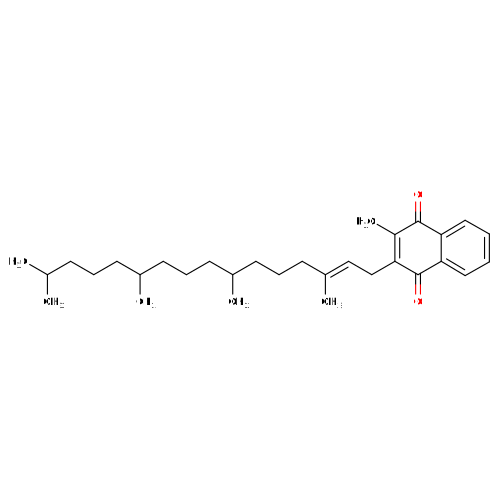
| Description | Vitamin K1, also known as phytonadione or mephyton, belongs to the class of organic compounds known as vitamin k compounds. These are quinone lipids containing a methylated naphthoquinone ring structure, and vary in the aliphatic side chain attached at the 3-position. Vitamin K1 is an extremely weak basic (essentially neutral) compound (based on its pKa). |
|---|
| CAS Number | 12001-79-5 |
|---|
| Structure | |
|---|
| Synonyms | |
|---|
| Predicted Properties | |
|---|
| Chemical Formula | C31H46O2 |
|---|
| IUPAC name | 2-methyl-3-[(2E)-3,7,11,15-tetramethylhexadec-2-en-1-yl]-1,4-dihydronaphthalene-1,4-dione |
|---|
| InChI Identifier | InChI=1S/C31H46O2/c1-22(2)12-9-13-23(3)14-10-15-24(4)16-11-17-25(5)20-21-27-26(6)30(32)28-18-7-8-19-29(28)31(27)33/h7-8,18-20,22-24H,9-17,21H2,1-6H3/b25-20+ |
|---|
| InChI Key | MBWXNTAXLNYFJB-LKUDQCMESA-N |
|---|
| Isomeric SMILES | CC(C)CCCC(C)CCCC(C)CCC\C(C)=C\CC1=C(C)C(=O)C2=CC=CC=C2C1=O |
|---|
| Average Molecular Weight | 450.6957 |
|---|
| Monoisotopic Molecular Weight | 450.349780716 |
|---|
| Classification |
|---|
| Description | Belongs to the class of organic compounds known as vitamin k compounds. These are quinone lipids containing a methylated naphthoquinone ring structure, and vary in the aliphatic side chain attached at the 3-position. |
|---|
| Kingdom | Organic compounds |
|---|
| Super Class | Lipids and lipid-like molecules |
|---|
| Class | Prenol lipids |
|---|
| Sub Class | Quinone and hydroquinone lipids |
|---|
| Direct Parent | Vitamin K compounds |
|---|
| Alternative Parents | |
|---|
| Substituents | - Diterpenoid
- Naphthoquinone
- Naphthalene
- Aryl ketone
- Quinone
- Benzenoid
- Ketone
- Organic oxygen compound
- Organic oxide
- Hydrocarbon derivative
- Organooxygen compound
- Aromatic homopolycyclic compound
|
|---|
| Molecular Framework | Aromatic homopolycyclic compounds |
|---|
| External Descriptors | |
|---|
| Ontology |
|---|
| Ontology | No ontology term |
|---|
| Physico-Chemical Properties |
|---|
| Physico-Chemical Properties - Experimental | |
|---|
| Spectra |
|---|
| Spectra | |
|---|
| EI-MS/GC-MS | | Type | Description | Splash Key | View |
|---|
| EI-MS | Mass Spectrum (Electron Ionization) | splash10-0ug0-9860500000-a5cd1646f1fc838bc7d7 | 2014-09-20 | View Spectrum | | Predicted GC-MS | Phytomenadione, non-derivatized, Predicted GC-MS Spectrum - 70eV, Positive | splash10-000i-6895400000-254b168b019b1fc92c97 | Spectrum |
|
|---|
| MS/MS | | Type | Description | Splash Key | View |
|---|
| Predicted MS/MS | Predicted LC-MS/MS Spectrum - 10V, Positive | splash10-0udi-0121900000-22d50aa41f7e3fa9b9da | 2016-08-03 | View Spectrum | | Predicted MS/MS | Predicted LC-MS/MS Spectrum - 20V, Positive | splash10-0apr-1679100000-60b28d715716b428496d | 2016-08-03 | View Spectrum | | Predicted MS/MS | Predicted LC-MS/MS Spectrum - 40V, Positive | splash10-0a4j-6592000000-1898f88b8876c5be2ea3 | 2016-08-03 | View Spectrum | | Predicted MS/MS | Predicted LC-MS/MS Spectrum - 10V, Negative | splash10-0002-0000900000-20c987b9d7c887aaedea | 2016-08-03 | View Spectrum | | Predicted MS/MS | Predicted LC-MS/MS Spectrum - 20V, Negative | splash10-0002-0101900000-ad51a9cf10696cc2c1cc | 2016-08-03 | View Spectrum | | Predicted MS/MS | Predicted LC-MS/MS Spectrum - 40V, Negative | splash10-0089-2924500000-7863f3ba8e25eb26d7e0 | 2016-08-03 | View Spectrum |
|
|---|
| NMR | | Type | Description | | View |
|---|
| 1D NMR | 1H NMR Spectrum (1D, 90 MHz, CDCl3, experimental) | | Spectrum |
|
|---|
| External Links |
|---|
| ChemSpider ID | 4444124 |
|---|
| ChEMBL ID | CHEMBL520156 |
|---|
| KEGG Compound ID | C02059 |
|---|
| Pubchem Compound ID | 5280483 |
|---|
| Pubchem Substance ID | Not Available |
|---|
| ChEBI ID | 18067 |
|---|
| Phenol-Explorer ID | Not Available |
|---|
| DrugBank ID | DB01022 |
|---|
| HMDB ID | HMDB03555 |
|---|
| CRC / DFC (Dictionary of Food Compounds) ID | HGN34-M:HGN34-M |
|---|
| EAFUS ID | 3864 |
|---|
| Dr. Duke ID | VIT-K|VITAMIN-K-1|VIT-K-1|PHYLLOQUINONE|VITAMIN-K |
|---|
| BIGG ID | 39000 |
|---|
| KNApSAcK ID | C00002868 |
|---|
| HET ID | Not Available |
|---|
| Food Biomarker Ontology | Not Available |
|---|
| VMH ID | Not Available |
|---|
| Flavornet ID | Not Available |
|---|
| GoodScent ID | Not Available |
|---|
| SuperScent ID | Not Available |
|---|
| Wikipedia ID | Vitamin K |
|---|
| Phenol-Explorer Metabolite ID | Not Available |
|---|
| Duplicate IDS | Not Available |
|---|
| Old DFC IDS | Not Available |
|---|
| Associated Foods |
|---|
|
| Biological Effects and Interactions |
|---|
| Health Effects / Bioactivities | |
|---|
| Enzymes | |
|---|
| Pathways | |
|---|
| Metabolism | Not Available |
|---|
| Biosynthesis | Not Available |
|---|
| Organoleptic Properties |
|---|
| Flavours | Not Available |
|---|
| Files |
|---|
| MSDS | Not Available |
|---|
| References |
|---|
| Synthesis Reference | Not Available |
|---|
| General Reference | Not Available |
|---|
| Content Reference | — Saxholt, E., et al. 'Danish food composition databank, revision 7.' Department of Nutrition, National Food Institute, Technical University of Denmark (2008).
— U.S. Department of Agriculture, Agricultural Research Service. 2008. USDA National Nutrient Database for Standard Reference, Release 21. Nutrient Data Laboratory Home Page.
— Duke, James. 'Dr. Duke's Phytochemical and Ethnobotanical Databases. United States Department of Agriculture.' Agricultural Research Service, Accessed April 27 (2004).
— Shinbo, Y., et al. 'KNApSAcK: a comprehensive species-metabolite relationship database.' Plant Metabolomics. Springer Berlin Heidelberg, 2006. 165-181.
|
|---|